
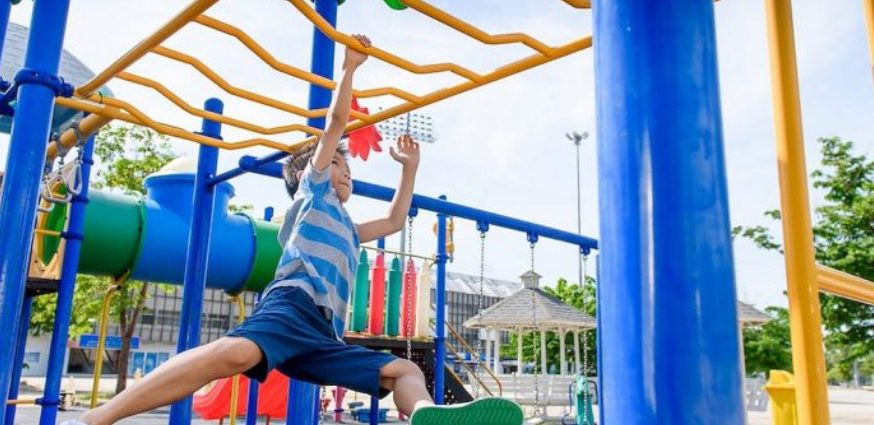
Some young children are essentially confined indoors, seldom venturing outside for play, according to a new poll.
Approximately 1 in 10 preschoolers and toddlers go outside to play once a week or less, according to results from the University of Michigan Health C.S. Mott Children’s Hospital National Poll on Children’s Health.
Outdoor play has been demonstrated to enhance children’s mental and physical health while also supporting good eye health, researchers noted.
Parental anxiety may present one obstacle, with 4 in 10 parents surveyed acknowledging they feel nervous when their child wanders too far or climbs too high.
Activities like tree climbing, bike riding, or sliding down a pole at the playground offer opportunities for development, Mott Poll Co-Director Sarah Clark explained in a news release.
Clark stated: “Parents understandably worry about safety but children need chances to test their limits. Climbing, swinging or exploring unfamiliar areas helps build confidence, resilience and problem-solving skills.”
Children’s Independent Play Activities
Overall, 75% of parents with 3- to 5-year-olds said their child uses swings independently, while 41% reported their child crosses monkey bars alone.
About 71% of 1- to 2-year-olds go down slides on their own, and 66% climb playground structure stairs, the poll found.
However, nearly half of parents hold their child’s hand or sit immediately beside them when the child attempts a new physical challenge, the poll revealed.
Clark noted: “Risky play isn’t about recklessness but about appropriate challenges that allow young children to explore what they’re capable of. Parents who allow a little more independence often see their child’s confidence flourish.”
She encourages parents to let children take the lead during playtime rather than directing them toward the “correct” way to play.
Clark said: “Play doesn’t need to be perfect or educational to be beneficial. Letting children lead their own play encourages curiosity, creativity and independence. Parents just need to create time and space for their children to play freely.”
Types of Daily Play
On a typical day, approximately 88% of children engage in physical play such as running, jumping, or climbing, the poll found. Another 68% participate in pretend or make-believe play.
Nearly one-third of parents say their child engages in media play, including video games, and 3 in 5 report their child watches TV or videos daily.
Clark stated: “Play is the key to how young children learn and develop. It starts in infancy, with parents playing peekaboo and as children become older, they create their own version of play.”
Recommendations for Parents
The findings suggest many families could support healthier development by encouraging a broader range of play experiences, Clark said.
She acknowledged: “Phones and tablets are convenient, and it’s understandable that parents rely on them at times. But it’s important to be mindful of how much time is spent in media play and to create opportunities for more active, imaginative and social play.”
The poll surveyed 710 parents with at least one child ages 1 to 5. The margin of error is plus or minus 2 to 7 percentage points.
This research highlights concerns about children’s outdoor play opportunities and the balance between protective parenting and allowing children the independence needed for healthy development.