
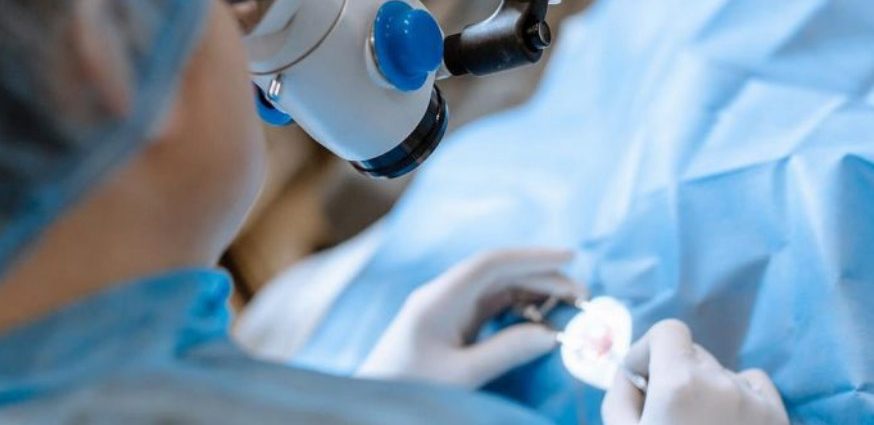
Scientists have successfully restored partial vision to people with a common form of blindness using a prosthetic retinal implant—a groundbreaking achievement that could eventually improve life for more than a million Americans with severe vision loss.
The new technology, developed by California-based Science Corporation, enabled 27 of 32 patients to regain sufficient sight to read black-and-white letters on an eye chart, according to a study published Monday in the New England Journal of Medicine.
Dr. Demetrios Vavvas, director of the retina service at Massachusetts Eye and Ear in Boston, told The New York Times: “This is at the forefront of science.”
Vavvas, who reviewed the findings, noted that while the implant isn’t a cure, it represents the beginning of a new technology that will continue advancing.
Target Condition and Patient Outcomes
The implant was tested in older adults with geographic atrophy, a type of age-related macular degeneration (AMD) that destroys cells in the center of the retina.
These cells are crucial for sharp, central vision required for reading, recognizing faces, and managing daily activities.
Participants, who averaged 79 years old, had previously been informed their vision loss was irreversible. Following surgery, their ability to see improved by an average of five lines on a standard eye chart, researchers reported.
How the Technology Works
The implant functions alongside a small camera and glasses that project infrared images onto a tiny wireless chip—approximately the size of a pinhead—implanted in the retina. The chip converts light into electrical signals that stimulate remaining retinal neurons, generating a black-and-white image.
Although the restored vision is blurry and low-resolution, the ability to read or detect shapes again proved “life-changing” for many participants, researchers said.
Advantages Over Current Treatments
The only existing treatments for geographic atrophy—pegcetacoplan and avacincaptad—merely slow vision loss rather than reversing it, and both require eye injections every one to two months.
Dr. Royce Chen, a Columbia University expert on macular degeneration who wasn’t involved in the study, told The Times that with those drugs, “basically you get worse slower.”
The possibility that patients could regain some vision “is amazing,” Chen added.
Dr. Ronald Adelman, chairman of ophthalmology at the Mayo Clinic in Florida, who also reviewed the findings, agreed. He described the results as “amazing” and noted that the research “brings hope.”
Safety Profile
Side effects occurred in 19 of the 32 patients, including increased eye pressure, small retinal tears, or bleeding. However, most complications were “manageable and resolved within two months,” researchers reported.
Development and Regulatory Status
The trial took place in Europe, where the device was developed by Pixium Vision, a French company later acquired by California-based Science Corporation.
The company has since applied to sell the device in Europe and is in discussions with the U.S. Food and Drug Administration (FDA) about bringing it to the United States.
Daniel Palanker, the Stanford University physicist who invented the device, said he began working on the concept more than 20 years ago. His team is already testing a newer implant offering better resolution that has shown promise in early trials.
This breakthrough represents a significant step forward in treating irreversible vision loss, offering hope to millions of people with age-related macular degeneration who previously had no options for regaining sight.